Words We Crave, Worlds We Create
The quote-genre
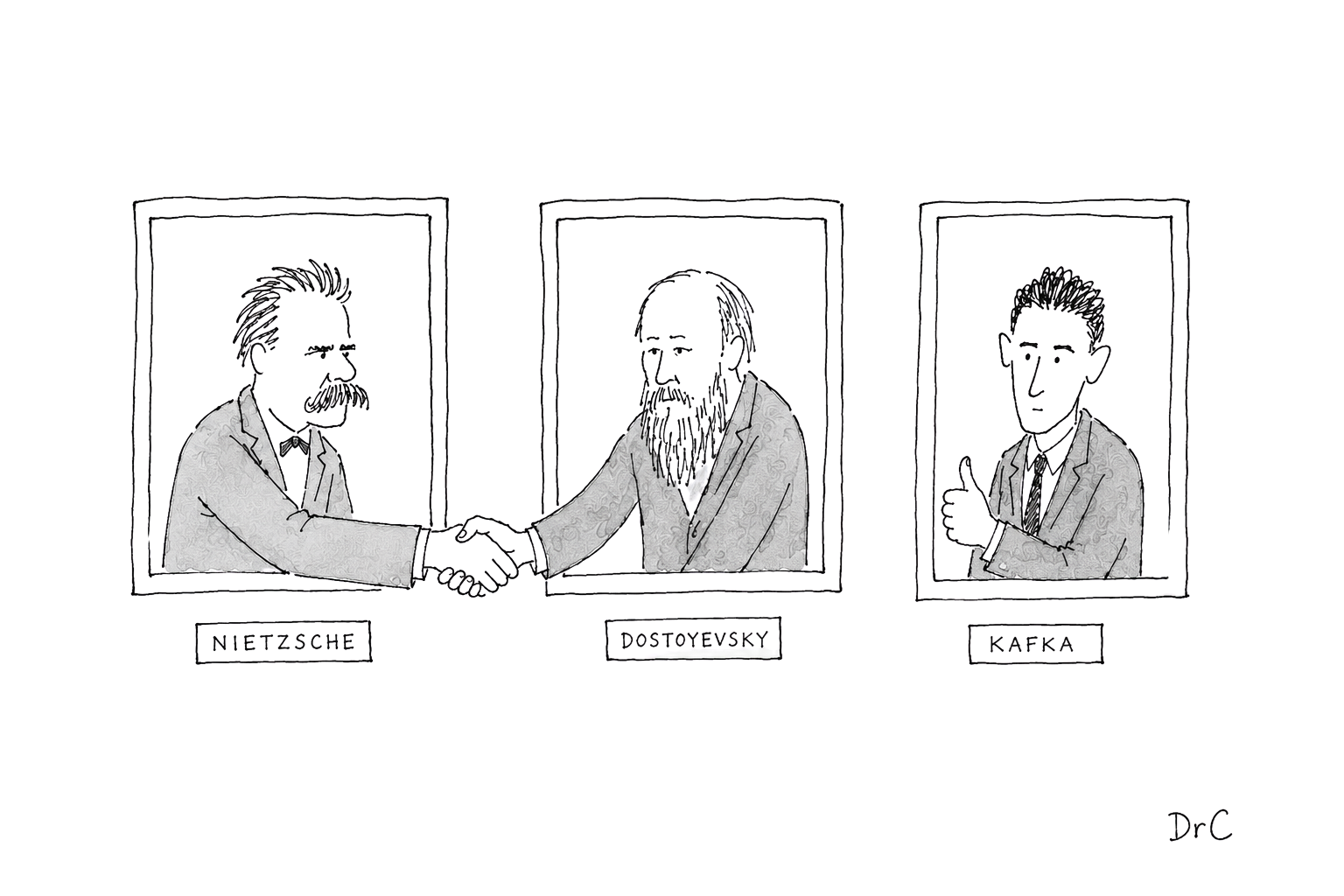
I keep encountering a family of quotes that circulate on social media. Together they resemble a stupid dialogue of three great men agreeing with each other. First Nietzsche says: "Sometimes people don't want to hear the truth because they don't want their illusions destroyed." A few days later something close to it appeared again, this time Dostoevsky replies: "People don't want truth, they want comfort dressed as truth." And next to him Kafka nods: "Yes, reality is too heavy, so they rent illusions and call it happiness." A reader, too, is probably ready to high five, because the idea feels intuitively correct, doesn't it? There isn't a woman in the list of greats for some reason, although later I found (I mean again - encountered by algorithmic accident) a quote by Anaïs Nin, who says something a bit different and, to my mind, much more intelligent. I'll get back to that.
An idea is out there that captures a generalized attitude towards illusions. Since it opposes truth, illusion here means a lie, in the sense of people lying to themselves. I've tried confirming the attributions, by the way, and they seem unreliable. This doesn't matter though. The aphorism floats free of its source because what people are quoting is themselves, in righteous indignation, identifying a weakness in everyone else.
Let's scrutinize the implication first. People prefer illusion to truth, therefore they are weak, dishonest, or [insert something else critical here]. There is a small pleasure in reading those quotes. Since you are reading them and agree, you are not the one being accused. You, unlike the masses, can stomach the truth, right?
The idea that people are drawn to illusions and maintain them, stripped of moral superiority, could actually be worth contemplating. The part the moralists tend to skip over - what if the great minds cited above are saying something less flattering to those who quote them? That people cannot live without illusion at all, because it is structurally necessary. If so, we have to drop the conceptually lazy opposition between truth and illusion.
"Do you miss me?"
gets asked many times a day, by people who are not particularly interested in the literal answer. The question is a small invitation: "Say yes (please)". If deciphered, "confirm the version of us in which I am present in your day, and honor the unspoken agreement to maintain a shared fiction of emotional stability in our relationship". Mind you, relationships fluctuate by nature. It is as obvious as it is evasive. The honest reply, "sometimes," or "I haven't thought about it," would puncture the illusion. We can feel betrayed when told the emotional truth. We can feel betrayed when our personal truth is not recognised. Betrayal deserves its own attempt at reasoning, so I'm pinning it for later. Let's just say that not being seen is what makes us suffer.
We have arrived at the idea that illusion is the connective tissue of ordinary intimacy (if only).
Truth breaks accord
Accord means consensus, and consensus is itself an illusion. Couples, families, friends, without ever putting it in writing, agree (illude?) on which version of their shared story they will play. None of these settlements survives close inspection - they are not meant to.
Telling the truth often means refusing the shared fiction someone is leaning on. Sometimes that is the right thing to do. Often it is an act of force passing as virtue. The online aphorism pretends the second case is the first. The pleasure of the quote depends on never asking what the accord was doing in the first place. So when a friend asks if you miss her, and you say yes a little more warmly than you feel, and she says she missed you too, neither of you is lying. You are both attending to the accord. Whether that is generosity or evasion depends on what the accord is for, and what it is costing.
Sane by what (The harmony of discordant things)
The same operation runs inside one head. A person alone, with no interlocutor to please, still keeps a working version of themselves. They mind-sculpture the answers to internal questions like who they are, what their childhood meant, why the last argument went the way it did, what their role is in significant relationships in their life. Would those hold up to a close look? Inner coherence is something a person maintains, like the consensus a couple keeps around a fight. The mind that produced the answers is the same mind doing the looking.
Enter the unflattering possibility to sit with. Illusion is one of the conditions a working mind runs on, the way air is a condition for speech. Pull it out, expecting clarity, and what arrives is a mind with nowhere to put what is happening.
The work beneath the words
Try this. You feel a sourness in the morning and cannot locate it. Something at the edge of the day before. By the time you have walked to the kitchen it has condensed: "I was hurt that he didn't ask." Before being put into words, into a thought even, the feeling was a raw sensation, an atmosphere. After producing a sentence you can do something with it. You can disagree with it, you can soften it, you can hold a grudge for a week, or you can forget. Now it's something the mind can hold. I know, forgetting doesn't seem like something you need verbalization for. But you do.
This is the work the British analyst Wilfred Bion called dreaming. Not dreaming in the nighttime sense, although it is continuous with that, but the everyday transformation of raw experience into thinkable form. He named the function that does the work the alpha function. Before something has been shaped, it cannot be thought. If experience has to be shaped before it can be thought, then the line between truth and illusion runs inside the shaping, not outside it. Every account of what happened is but a version.
This is what the moralists of the quote-genre probably miss. I believe they imagine truth as unmediated, sitting there, waiting for someone courageous enough to receive it. Truth in that form is flood-like. A sudden bereavement, an accident, a diagnosis delivered too quickly. There is no shortage of information in the room. There is only too much. Overwhelming. The work that turns information into something a person can carry is the same work the aphorism is sneering at.
In this sense, reality takes the form of Illusion, so we can live it.
Handling
People survive through illusion.
The choice between honesty and comfort was never available in the form the aphorism imagined. It is true though that the argument starts to feel dangerous here. If illusion stabilizes psychic life, lying begins to look benevolent, and manipulation becomes a gift.
The dystopian fear is fair, but there is, paradoxically, a kind of truth in giving people the illusions they want. Will that truth be generous or corrosive? It depends, illusions differ. Some hold a room together while a child sleeps. Some keep a marriage from facing what it has become. Some get sold to a country in the run-up to a war. The same formal structure, the working consensus that lets people go on, can shelter, dull, or weaponize depending on what it is doing and for whom.
The fourth quote is by Anaïs Nin (diary entry, October 1933): "When others asked the truth of me, I was convinced it was not the truth they wanted, but an illusion they could bear to live with." Sadly this quote too gets turned into an accusation by cutting its opening clause: "It was not the truth they wanted, but an illusion they could bear to live with." Thank you, Anaïs Nin, for this insightful self-observation.
So, do we sustain illusions? Sure, we do. The real question has several parts: which ones we are inside of right now, what they are letting us live with, and what they are costing us to keep. That question does not answer itself in a sentence pinned to a portrait.